
If you've started researching what to do about mold in your home, you've probably run into two terms used almost interchangeably: “removal” and “remediation.” They sound similar, but they describe different levels of work—and knowing the difference can save you money and prevent a recurring problem. Understanding mold remediation in Colorado helps homeowners choose the right approach instead of paying for the wrong one or, worse, treating only half the problem.
The distinction matters because mold is rarely just a surface issue. Wiping away what you can see doesn't touch the moisture and hidden growth driving it, which is why a quick “removal” so often leads to regrowth weeks later. At Prime Environmental, we help Colorado homeowners understand exactly what their situation calls for, find the source, and resolve it properly. This guide breaks down the difference between removal and remediation, when each is appropriate, and what a professional process actually involves.
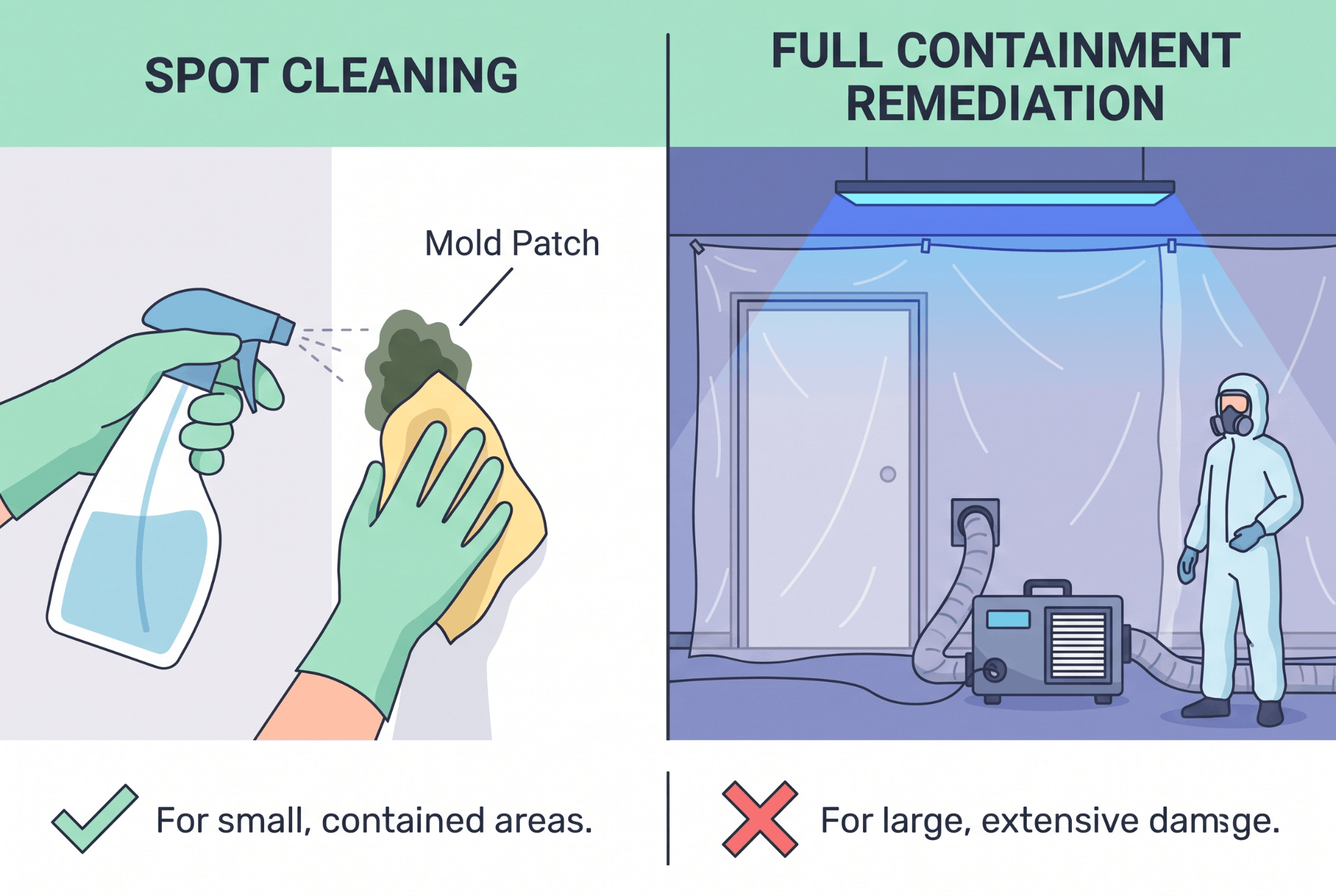
At first glance the two terms seem to describe the same task, but in practice mold remediation in Colorado covers far more than removal alone. Understanding what each word actually means is the foundation for making the right decision about your home.
Mold removal refers to the physical act of taking mold away from a surface—scrubbing it off, wiping it down, or discarding a moldy item. It addresses the visible symptom. Remediation, by contrast, is the complete process of returning an indoor space to a normal, healthy condition. That includes identifying and correcting the moisture source, containing the area to prevent spread, removing contaminated materials, treating surfaces, drying the structure, and verifying the result. Removal is one step inside the larger process of remediation.
The reason the industry favors the word remediation is that mold is never truly a standalone problem—it's the visible result of a moisture condition. As the EPA explains in its mold remediation guidance, controlling moisture is the essential factor in preventing mold, and any cleanup that ignores the water source is incomplete by definition. So when homeowners ask whether they need removal or remediation, the honest answer is that they almost always need remediation; removal is simply the part they can see.
The most common and costly mistake in mold remediation in Colorado is treating mold as a cleaning problem rather than a moisture problem. Surface cleaning alone feels like progress, but without source control it's usually a temporary fix that sets up the next round of growth.
Mold exists everywhere as microscopic spores floating in the air. They only bloom into a visible colony when they land on a damp surface with something to feed on—wood, drywall paper, dust, or organic residue. Scrub away the colony but leave the dampness, and new spores simply settle and regrow in the same spot. You end up cleaning the same corner again and again, watching it return each time, because the underlying condition never changed.
Bleach deserves a special mention here, because it's the go-to DIY remedy and one of the least effective. On porous materials, bleach may bleach the stain to invisibility while the mold's roots remain embedded below the surface, and the water content can even add moisture to the very problem you're trying to solve. Effective remediation flips the priority: it treats the moisture first—whether that's a leak, condensation, or humidity—so the environment no longer supports growth. That's why our team pairs mold work with water damage restoration whenever a water source is involved, resolving the cause and the symptom together.
One of the biggest differences between a DIY wipe-down and professional mold remediation in Colorado is what happens to the spores you disturb. Cleaning mold without containment can spread it far beyond the original site, which is why the professional process is built around isolation and air control.
This is the part of remediation that homeowners simply can't replicate with household tools, and it's what prevents a contained problem from becoming a whole-house one. Disturbing a mold colony without these protections is a leading reason small issues spread into new areas after a well-meaning DIY attempt.
Not every bit of mold demands a full professional response, and part of understanding mold remediation in Colorado is knowing where that line falls. Some small situations are reasonable to handle yourself; others clearly aren't.
General guidance from environmental authorities suggests that a small area of mold—roughly ten square feet or less—on a hard, non-porous surface, tied to an obvious and easily corrected moisture source, can often be cleaned safely by a homeowner using proper protective equipment. Think of a small patch of surface mold around a shower fixture or on a window sill, where the cause is clear and the surface wipes clean.
Professional help is the right call when the situation is bigger or murkier. That includes mold covering a large area, growth on porous materials like drywall or carpet, mold that keeps coming back after cleaning, any mold linked to contaminated water, and situations where you smell mold but can't find it. Health considerations matter too: if anyone in the home has asthma, allergies, or a compromised immune system, even a modest mold problem is worth professional handling. And whenever hidden or recurring growth suggests a moisture source you can't see or control, remediation—not removal—is what the home actually needs. When in doubt, an assessment is far cheaper than repairing the spread from a DIY attempt gone wrong.
The final piece that distinguishes professional mold remediation in Colorado from a simple cleanup is verification. A clearance check is how you know the work actually succeeded, rather than just looking finished.
After remediation is complete, a clearance evaluation confirms that the affected area has been returned to a normal condition—that visible growth is gone, surfaces are properly treated, and the space has been dried so conditions no longer favor regrowth. It's the objective proof that turns “it looks clean” into “it's verified clean,” which matters enormously for your health, your peace of mind, and your home's value if you ever sell.
Importantly, this verification is kept independent. Any sampling or laboratory analysis used to confirm results is performed by a third-party firm rather than by the company doing the remediation, so the clearance is objective and free of any conflict of interest. That separation is a hallmark of doing the job right. Prime Environmental focuses on the remediation itself—finding the source, removing the growth, and restoring the space—while independent labs handle confirmation, giving you results you can trust. For homeowners dealing with recurring moisture below the home, addressing the root cause through services like mold remediation and moisture control is what makes clearance stick for the long term.
When homeowners weigh mold remediation in Colorado against a cheaper surface removal, the price difference on paper can be tempting. But the real cost comparison only makes sense when you account for what happens after the work is done.
A surface-only removal is almost always cheaper up front, and for a genuinely small, non-porous, source-corrected spot, that can be the right call. The problem appears when removal is used on a larger or moisture-driven issue it was never going to solve. The mold returns, often within weeks, and now you're paying a second time—this time for a bigger footprint, because the growth continued spreading behind the surface while it looked handled. Add the possibility of damaged materials that could have been saved with prompt drying, and the “cheaper” option quietly becomes the more expensive one.
Proper remediation costs more initially because it does more: it finds and fixes the moisture, contains the area, removes what can't be saved, and verifies the result. But because it resolves the actual cause, it's typically a one-time expense rather than a recurring one. There's also the value that's harder to put a number on—protecting your indoor air, avoiding repeated disruption to your household, and having documentation that reassures a future buyer. For most Colorado homeowners facing anything beyond a trivial spot, remediation isn't the pricier choice; it's the one that actually ends the problem.
If you're unsure whether your home needs simple removal or full remediation, the safest first step is a professional evaluation. Guessing wrong—or cleaning only the surface—often means paying twice when the mold returns. Our certified team will identify the moisture source, scope the right level of work, and restore your home properly the first time.
📞 Call Prime Environmental at (303) 720-5111 to schedule a mold remediation consultation for your Colorado home.
Mold can return after remediation only if the underlying moisture source isn't corrected. Proper remediation is designed specifically to prevent this by identifying and fixing the water problem—whether a leak, condensation, or high humidity—so conditions no longer support growth. When the source is addressed and the area is thoroughly dried, regrowth is unlikely. If mold does come back, it's almost always a sign that a moisture issue remains, which is why source control is treated as the core of the process rather than an afterthought.
As a general rule, mold covering more than about ten square feet, mold on porous materials like drywall or carpet, or any growth tied to contaminated water warrants professional remediation. Hidden mold, growth that keeps returning, and situations where occupants have asthma, allergies, or weakened immune systems also call for a professional. Smaller surface patches on hard, non-porous materials with an obvious, correctable moisture source can sometimes be handled at home, but anything beyond that is safer and more effective with certified help.
Coverage depends on your policy and, crucially, the cause of the mold. Many homeowners policies cover mold remediation when it results from a sudden, accidental, covered event—like a burst pipe—while mold caused by long-term neglect or unresolved maintenance issues is often excluded. Because the cause determines coverage, documentation matters, and working with a team that provides clear records and estimates helps support your claim. Reviewing your specific policy and speaking with your insurer is the best way to confirm what applies to your situation.
Our team of certified professionals is always ready to protect your home or business. Contact us today and get a FREE estimate.
.svg)

.svg)
.avif)