
A flooded basement in Denver has a way of turning an ordinary day upside down, and how you respond in the first hours shapes whether it becomes a manageable cleanup or a long, expensive recovery. Whether the water came from spring snowmelt, a summer storm, a failed sump pump, or a burst pipe, the priorities are the same: stay safe, stop the source, and get the moisture out fast, because the real threat after a flooded basement in Denver is often the mold that follows the water. Understanding the recovery process, and where the hidden dangers lie, is what protects your home and your health.
The trouble with basement flooding is that the water you can see is rarely the whole story. Water soaks into drywall, wicks up into framing, saturates carpet padding and subfloor, and pools in cavities where it sits unseen. That trapped moisture is what creates the damp conditions mold needs to establish, often within a day or two of the flood.
At Prime Environmental, our focus is the environmental aftermath of a basement flood: making sure the moisture left behind is fully addressed so it doesn’t become the hidden mold problem homeowners discover weeks later. This guide walks through the immediate safety steps, how to identify the water source, the drying timeline, what can be saved, and how professional mold remediation protects your home after the water is gone.

Before anything else, a flooded basement is a safety situation, not just a cleanup. Standing water combined with electricity or gas can be dangerous, so the first priority is to protect yourself and your household before you begin dealing with the water itself.
Electricity is the most urgent concern. If there are outlets, appliances, or an electrical panel near the water, and you can reach your breaker box safely and without standing in water, cut power to the affected area. If you cannot reach it safely, or if the panel itself is near the water, stay out and call an electrician or your utility. Gas is the second concern: if you smell gas or suspect a leak, leave the home and call your gas company. Only once you are confident the area is electrically safe should you enter the water, and even then, be mindful that floodwater can hide sharp objects, displaced items, and uneven footing.
These precautions matter because the instinct to rush in and start saving belongings is strong, but a basement full of water is exactly where that instinct can lead to injury. Once the space is safe to enter, the focus shifts to understanding where the water came from and how serious it is.
If the water is deep, rising, or in contact with electrical panels or gas appliances, the safest choice is to stay out entirely and call professionals. The same is true if the water may be contaminated, such as from a sewer backup or storm runoff. There is no belonging worth an electric shock or exposure to hazardous water, and a professional crew is equipped to enter and stabilize a flooded space safely when it is not safe for a homeowner to do so.
Once the basement is safe to enter, the next step is to understand two things: where the water is coming from, and what kind of water it is. Both determine how the recovery should proceed and how urgent the health considerations are.
Finding the source is what allows the flooding to actually be stopped rather than just mopped up. Common Denver sources include groundwater seeping through foundation cracks after snowmelt or heavy rain, storm runoff entering through window wells, a failed or overwhelmed sump pump, and plumbing failures such as a burst supply line or a backed-up drain. If the source is an ongoing leak, stopping it, by shutting off the water supply, clearing a window well, or addressing a failed pump, is essential before drying can succeed.
Equally important is the category of the water, because it dictates the health risk. Clean water from a supply line is one thing; gray water from an appliance, or black water from a sewer backup or storm runoff, carries contamination that makes professional handling important. The restoration industry classifies water into three categories of increasing hazard, and knowing which one you are dealing with is central to a safe recovery.
Category 1 is clean water from a sanitary source, such as a broken supply line. Category 2, or gray water, contains some contamination and can cause discomfort if contacted, for example water from a dishwasher or washing machine. Category 3, or black water, is grossly contaminated and can contain harmful bacteria and other hazards, including sewage backups and floodwater from storm runoff. As water sits, it can also degrade from one category to a worse one over time. Category 2 and 3 water in particular calls for professional, protective handling rather than a do-it-yourself approach.
Getting a basement dry is a process with a timeline, and understanding it helps set realistic expectations. The goal is not simply to remove the water you can see but to return the entire structure, including the parts you cannot see, to a genuinely dry state before mold has a chance to establish.
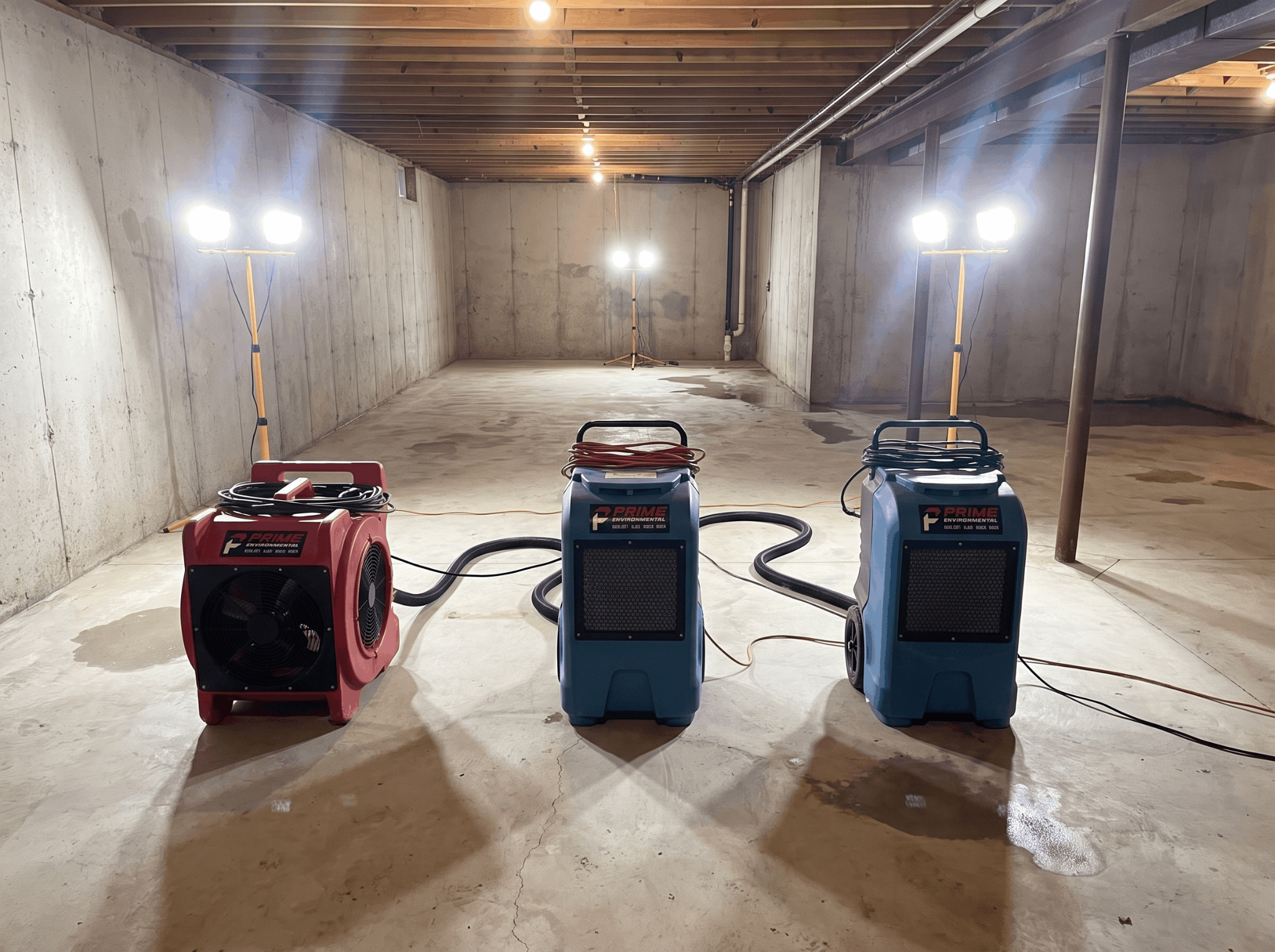
The process generally begins with extraction, physically removing standing water using pumps and extraction equipment. Next comes the removal of unsalvageable saturated materials that would otherwise trap moisture, followed by structural drying, where air movers and dehumidifiers work together to pull moisture out of framing, subfloor, and remaining materials. Throughout, moisture levels are monitored so the drying continues until the structure reaches normal moisture content rather than stopping when surfaces merely feel dry. Depending on how much water was involved and how far it penetrated, this typically takes several days, and rushing it, or assuming the job is done because the floor looks dry, is what leaves hidden moisture behind to feed mold.
This distinction between surface-dry and structurally dry is the crux of a proper recovery. It is also why professional drying with proper equipment and monitoring matters so much: the difference between a basement that is truly dry and one that merely appears dry is invisible to the eye but decisive for whether mold takes hold.
One of the hardest parts of a basement flood is deciding what can be dried and kept versus what has to go. The answer depends on the material, how long it was wet, and the category of water involved, and making the right call is important both for a clean recovery and for preventing mold.
As a general guide, non-porous materials like metal, sealed concrete, and solid wood can often be cleaned, dried, and saved. Semi-porous materials may be salvageable depending on exposure. Porous materials, drywall, insulation, carpet padding, and particleboard, that have absorbed water, especially contaminated water, frequently cannot be dried reliably and are usually removed to eliminate hidden moisture and any contamination they hold. The longer materials stay wet and the more hazardous the water, the more that must be removed rather than saved.
It can be painful to discard belongings and building materials, but leaving saturated porous materials in place is one of the most common ways a flood turns into a mold problem. Removing them is what allows the structure to dry fully and the space to be restored safely, which is central to the environmental focus of a proper recovery.
Drywall and insulation are highly absorbent, and once they soak up floodwater they hold moisture against the framing and lose their integrity. Wet insulation loses its function and stays damp for a long time, and saturated drywall wicks water upward and breaks down. Both are difficult or impossible to dry thoroughly in place, so they are typically cut out and replaced. This is not overcaution; it is the reliable way to remove hidden moisture and, when the water was contaminated, the contamination that comes with it.
The most important, and most overlooked, part of recovering from a flooded basement is what happens to the moisture left behind. Removing the visible water is only the beginning; it is the hidden dampness in walls, subfloor, and cavities that determines whether the flood becomes a mold problem. This is precisely where Prime Environmental’s focus on mold remediation and environmental recovery comes in.
Mold needs only moisture, an organic surface, and a little time, often just 24 to 48 hours, to establish. A basement flood provides all three in abundance, and because the moisture hides in materials and cavities, it can feed growth for days before anyone notices. Thorough professional drying addresses the moisture at its source so those conditions never develop, and where growth has already begun, proper containment, removal of affected materials, and treatment stop it from spreading through the home.
The benefits of getting this right include:
Because the mold that follows a basement flood is so often the longer-lasting threat, making sure the moisture is fully addressed is what turns a stressful flood into a complete recovery rather than the first chapter of a mold problem. If your basement has flooded, you can contact our team to make sure the moisture is fully addressed.
📞 Call Prime Environmental at (303) 720-5111 for basement flood drying and mold prevention across the Denver area.
It usually takes several days, though the exact time depends on how much water was involved, how far it penetrated, and the materials affected. The key point is that being surface-dry is not the same as being structurally dry. Proper drying uses air movers and dehumidifiers together with moisture monitoring, and continues until framing and subfloor reach normal moisture content, not just until the floor feels dry to the touch. Because mold can establish within 24 to 48 hours, starting professional drying quickly is what keeps the timeline, and the damage, as short as possible.
For a small amount of clean water, a rented pump or wet vacuum may help you begin removing standing water. But a rented pump only addresses the water you can see; it does nothing about the moisture that soaks into drywall, insulation, subfloor, and wall cavities, which is what actually feeds mold. It also does not address contaminated water safely. For anything beyond a minor clean-water event, professional extraction and structural drying, with the equipment and monitoring to dry the structure fully, is what prevents a flood from becoming a mold problem weeks later.
Often, yes, if it absorbed floodwater. Drywall is highly porous, so once it soaks up water it holds moisture against the framing, loses its integrity, and is very difficult to dry reliably in place. When the water was contaminated, the drywall also holds that contamination. For these reasons, saturated drywall is usually cut out and replaced rather than dried, which allows the structure behind it to dry completely and removes a common hiding place for mold. Drywall that was only lightly or briefly exposed to clean water may sometimes be saved, but a professional assessment is the reliable way to tell.
Not always, but the risk is high whenever moisture is left in materials. Mold needs moisture, an organic surface, and time, and a basement flood provides all three if the water isn’t removed and the structure dried promptly and thoroughly. When the water is fully extracted and the structure is dried within the first day or two, mold often never develops. The determining factor is the hidden moisture: address it completely and mold is unlikely, but leave dampness inside walls, subfloor, and cavities and growth becomes probable.
It depends on how the water entered and your specific policy. Many homeowners policies cover sudden, accidental water damage such as a burst pipe, while damage from groundwater or surface flooding is often handled differently or requires separate flood coverage. Coverage varies, so reviewing your policy and speaking with your insurer is the best way to confirm what applies. Thorough documentation of the damage before cleanup begins, including photos and video, gives your claim the strongest support. Prime Environmental provides detailed documentation and works with insurance carriers to support the environmental portion of a claim.
Our team of certified professionals is always ready to protect your home or business. Contact us today and get a FREE estimate.
.svg)

.svg)
.avif)